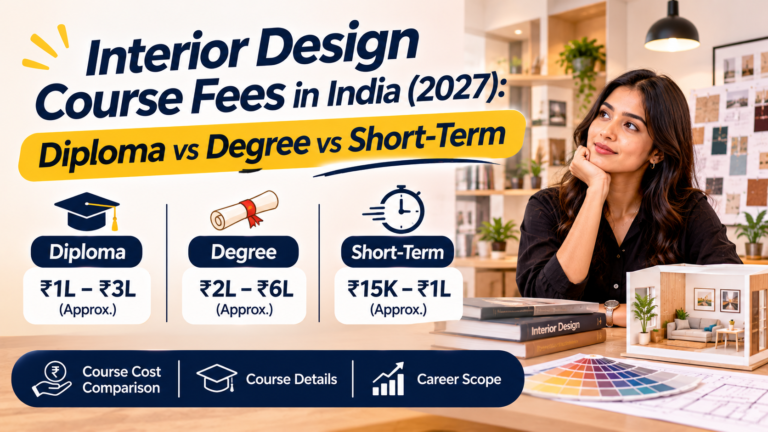
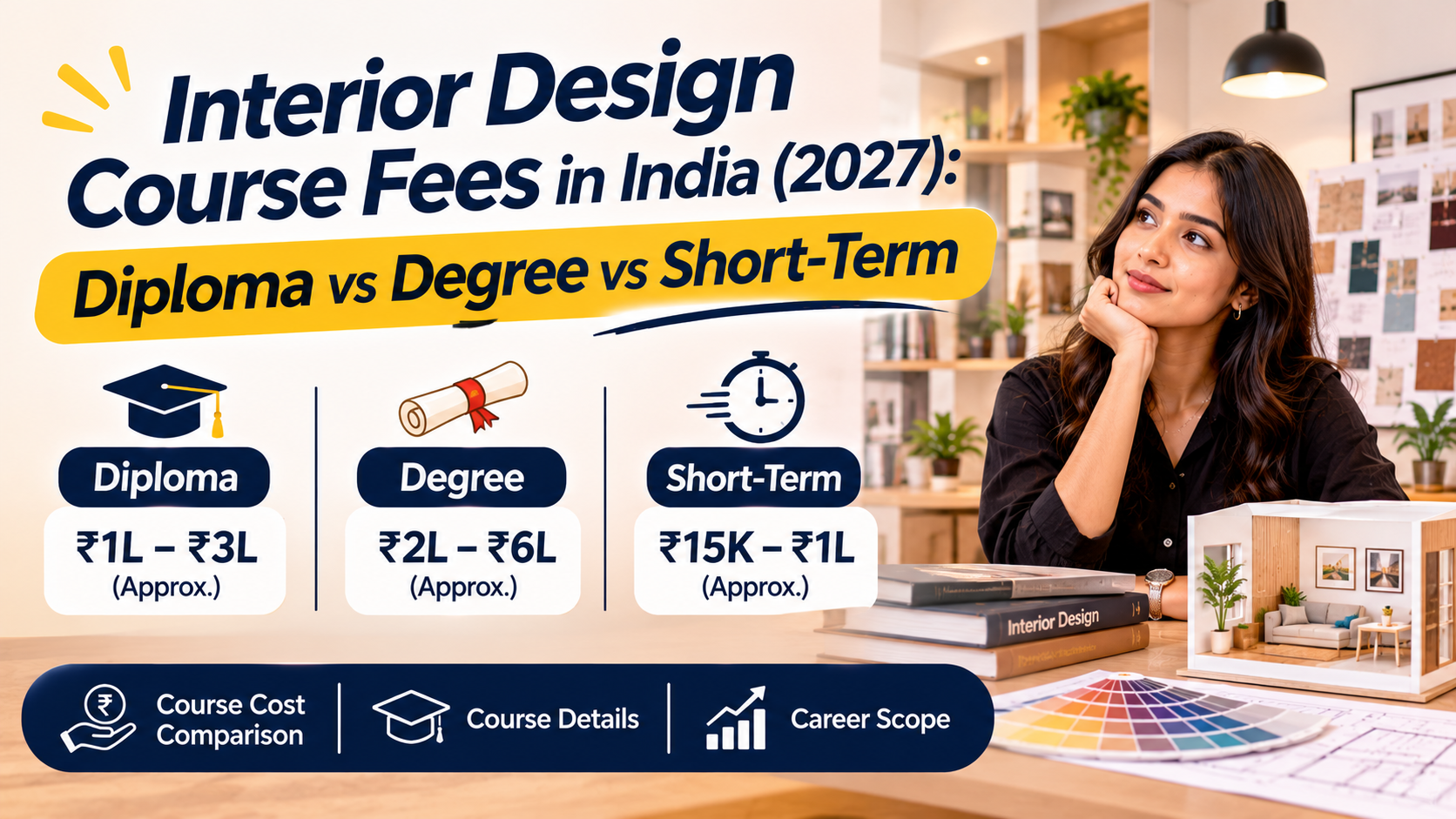
Interior Design Course Fees in India (2027): Diploma vs Degree vs Short-Term
Quick answer: Interior design course fees in India range from roughly ₹15,000–₹60,000 for short-term certificates to ₹3,00,000–₹8,00,000+ for a full bachelor’s degree. Diplomas typically sit between ₹80,000 and ₹3,00,000, depending on duration, accreditation, and whether the institute includes software training and placement support.
Interior design course fees vary this much because no two programs teach the same thing in the same amount of time. A six-month certificate covers software basics and styling fundamentals. A four-year degree covers structural drawing, materials engineering, and a full design studio portfolio. This guide breaks down what you’ll pay at each level, what drives the price up or down, and how to match a course to your budget — so you can shortlist options with real numbers in hand, not guesswork.
Interior Design Course Fees in India at a Glance
Here’s how the major course types compare on duration, typical cost, and who each one suits best.
| Course Type | Duration | Typical Fee Range (INR) | Best For |
|---|---|---|---|
| Short-term certificate | 3–6 months | ₹15,000–₹60,000 | Working professionals, hobbyists, quick skill add-ons |
| Diploma | 1–2 years | ₹80,000–₹3,00,000 | Students after 12th seeking job-ready skills faster than a degree |
| B.Des / B.Sc / BID (Bachelor's) | 3–4 years | ₹3,00,000–₹8,00,000+ | Students who want a full degree and long-term career depth |
| PG Diploma / Masters | 1–2 years | ₹1,50,000–₹4,00,000 | Graduates specializing or switching careers into design |
| Online courses | 3 months–2 years | ₹10,000–₹1,50,000 | Remote learners prioritizing flexibility over campus access |
Short-Term Interior Design Course Fees (3–6 Months)
Short-term interior design courses cost between ₹15,000 and ₹60,000 for a 3- to 6-month program. These courses focus on a narrow set of skills — usually software tools like AutoCAD or SketchUp, basic space planning, or styling techniques — rather than the full design curriculum.
This format suits two kinds of learners: working professionals who want to add a specific skill without quitting their job, and students testing whether design is the right career before committing to a longer program.
Choose a short-term certificate if speed and low upfront cost matter more than a formal credential. Skip it if you need a qualification that colleges or large design firms recognize for entry-level hiring — most short-term certificates aren’t accredited the way diplomas and degrees are.
Diploma in Interior Design Fees
Diploma in interior design fees typically range from ₹80,000 to ₹3,00,000 for a 1- to 2-year program. The spread is wide because “diploma” covers everything from a government polytechnic certificate to a private institute’s intensive, studio-heavy program.
A one-year diploma generally sits at the lower end of that range and covers foundational design theory, basic software, and introductory studio projects.
A two-year diploma costs more but adds advanced software training, live project work, and often a placement cell — which matters if your goal is to start working immediately after the course.
Decision criteria: Choose a one-year diploma if you want to enter the workforce fast and plan to learn advanced skills on the job. Choose a two-year diploma if you want deeper studio experience and stronger placement support before you start job-hunting.
Bachelor's Degree (B.Voc / B.Sc / BID) Fees
A Bachelor’s degree in interior design — B.Voc, B.Sc Interior Design, or BID — costs ₹3,00,000 to ₹8,00,000 or more across 3 to 4 years, depending on whether the college is government-run or private.
This is the most comprehensive route. Degree programs include structural and materials engineering, building codes, advanced CAD and BIM software, and a full design thesis or capstone project. Many recruiters — particularly larger architecture and design firms — list a bachelor’s degree as a preferred qualification for design roles with growth potential.
Choose a bachelor’s degree if you’re planning a long-term career in interior design and want the broadest skill base and strongest formal credential. The higher fee and longer timeline pay off in career flexibility, since a degree qualifies you for roles a diploma alone may not.
PG Diploma and Masters in Interior Design Fees
PG Diploma and Masters programs in interior design cost ₹1,50,000 to ₹4,00,000 for 1 to 2 years of study. These programs are built for graduates — either from a related field like architecture, or from a completely different background who want to pivot into design.
Masters programs go deeper into specialization: sustainable design, commercial space planning, or design management, for example. A PG Diploma tends to be shorter and more skills-focused than a full Masters, which includes research and thesis components.
If you already hold a degree in a related field, a PG Diploma gets you job-ready faster and at a lower cost than starting a fresh bachelor’s program.
Online Interior Design Course Fees
Online interior design courses cost ₹10,000 to ₹1,50,000, covering everything from short software tutorials to full online diploma-equivalent programs that run a year or more.
Online fees are generally lower than campus-based equivalents because institutes save on studio space, materials, and in-person faculty time. The tradeoff is hands-on practice: software skills transfer well online, but studio critique, material handling, and site visits are harder to replicate remotely.
Choose an online course if you need flexibility — working professionals, those in smaller cities without access to a design institute, or anyone testing interest before committing to a full-time program. Choose an in-person course if hands-on studio work and direct mentorship matter more to your learning style than convenience.
Government vs Private College Fees
Government interior design colleges typically charge lower fees than private institutes [verify] for programs of similar duration, since they’re subsidized and admission is usually merit- or entrance-exam-based.
Private colleges and institutes charge more, but often offset that cost with smaller class sizes, newer software labs, dedicated placement cells, and faster admission timelines (no waiting on a national entrance exam cycle).
Decision criteria: Choose a government college if budget is your primary constraint and you’re comfortable with a competitive admission process. Choose a private institute if you want faster enrollment, more individual faculty attention, or a program structure built around specific skills like AutoCAD, Vastu, or landscape design.
What Affects Interior Design Course Fees?
Several factors explain why two programs of the same duration can have very different price tags.
- Duration- Longer programs cost more in total, but not always more per month — some short intensive courses charge a premium for compressed timelines.
- Accreditation- Accredited diplomas and degrees, recognized by state or national education bodies, often cost more than unaccredited certificate courses.
- Software training- Courses that include licensed software like AutoCAD, SketchUp, 3ds Max, or BIM tools typically charge higher fees to cover licensing and lab infrastructure.
- Placement support- Institutes with dedicated placement cells and industry tie-ups usually build that cost into tuition.
- Studio and practical work- Hands-on studio time, live client projects, and site visits increase costs compared to lecture-only formats.
- City- Institutes in metro cities generally charge more than those in smaller cities, reflecting higher operating costs.
Review each of these factors against a shortlisted program’s prospectus before comparing fees side by side — the lowest sticker price isn’t always the lowest total cost once you add software, materials, and travel.
Hidden Costs to Budget For
The quoted course fee rarely covers everything you’ll spend to complete an interior design program. Budget separately for these costs:
- Software licenses: Some institutes include software in tuition; others expect you to purchase or subscribe separately.
- A laptop: Design software like AutoCAD and SketchUp requires a reasonably powerful laptop, which is a one-time cost outside the course fee.
- Materials: Model-making, sketching supplies, and sample boards add up over a full program.
- Site visits: Travel and entry costs for factory tours, vendor showrooms, or live project sites.
- Portfolio printing: A professional portfolio — essential for job interviews and freelance pitches — adds a final cost near the end of your course.
Key takeaway: Ask any shortlisted institute for a full cost breakdown, not just the headline tuition figure, before you enroll.
Is an Interior Design Course Worth the Fees?
Interior design course fees are an investment in a career with genuine long-term scope, provided you choose a course level that matches your career goals. Starting salaries for junior interior designers in India vary by city, employer type, and specialization [verify], and they tend to rise with portfolio strength and software proficiency rather than years of study alone.
The career scope extends beyond residential design into commercial interiors, retail and hospitality spaces, set design, and furniture and product design. Graduates with strong software skills and a well-built portfolio are generally better positioned for placement, regardless of whether they hold a diploma or a degree.
Choose a course level based on how far you want to go: a short-term certificate suits a specific skill gap, a diploma suits fast entry into the field, and a degree suits long-term career building with broader opportunities.
How to Choose the Right Course for Your Budget
Match the course type to both your budget and your timeline using this simple framework:
- Set a realistic total budget — including hidden costs like software, laptop, and materials, not just tuition.
- Decide your timeline- If you need to start earning within a year, a diploma or short-term certificate fits better than a degree.
- Check accreditation for any diploma or degree program, since this affects recognition by employers and eligibility for further study.
- Compare placement support across shortlisted institutes — ask for actual placement data, not general claims.
- Visit the campus or studio if possible, to assess software labs and practical training facilities firsthand.
- Talk to current students or alumni about their actual experience, workload, and job outcomes.
Why Choose Sukriti's 6-Month Interior Design Course
Sukriti Professional Academy runs a 6-month interior design course designed for students and working professionals who want job-ready design and software skills without committing to a multi-year program. The curriculum covers space planning, design software, and practical studio work, backed by Sukriti’s placement network of design studios and interior firms across Delhi, Noida, and Greater Noida.
If you’re weighing a short-term certificate against a longer diploma, a free counselling session can help you figure out which path fits your budget and career goals. Book a session or check the current batch schedule to get started.
Frequently Asked Questions
What is the fee for an interior design course in India?
Fees range from roughly ₹15,000 for a short certificate to ₹8,00,000 or more for a full bachelor’s degree. The exact cost depends on course duration, accreditation, city, and whether software training and placement support are included.
Which interior design course is cheapest?
What is the fee for a 6-month interior design course?
A 6-month interior design course typically costs between ₹15,000 and ₹60,000, depending on the institute and whether software licenses or materials are included in that fee.
Are online interior design courses cheaper?
Yes, online courses generally cost less than equivalent in-person programs, often ranging from ₹10,000 to ₹1,50,000. The savings come from lower infrastructure costs, though online formats offer less hands-on studio and site-visit experience.
Is a diploma or degree better for interior design?
Choose a diploma if you want to enter the workforce faster and at a lower cost; choose a degree if you want broader career opportunities and are willing to invest 3–4 years and a higher fee. Both paths can lead to design careers — the right choice depends on your timeline and long-term goals.
Can I pay interior design course fees in instalments?
Many institutes, including private academies, offer instalment plans to spread tuition across the course duration. Always confirm instalment terms directly with the institute before enrolling, since policies vary widely.
Choosing the Right Course Starts With the Right Information
Interior design course fees in India span a wide range, but the right number for you depends on your budget, timeline, and career goals — not just the lowest price on offer. Shortlist two or three institutes, request a full cost breakdown including hidden expenses, and compare placement outcomes before you enroll.
If you’re still deciding between a short-term course, a diploma, or a full degree, talk to a Sukriti Professional Academy counsellor to get a clear, honest breakdown of fees and outcomes for your specific situation.
Interior Design Course Fees in India (2027): Diploma vs Degree vs Short-Term Quick answer: Interior design course fees in India range from …

How Flush Door Is Made: Section, Configuration & Details Quick answer: A flush door is made by building a solid or hollow …
How Plywood Is Made: Plywood Section, Configuration & Grades Quick answer: How plywood is made involves peeling logs into thin veneer sheets, …
How Block Board Is Made: From Core Strips to Commercial Panels Quick answer: Block board is manufactured by sandwiching strips of softwood …