
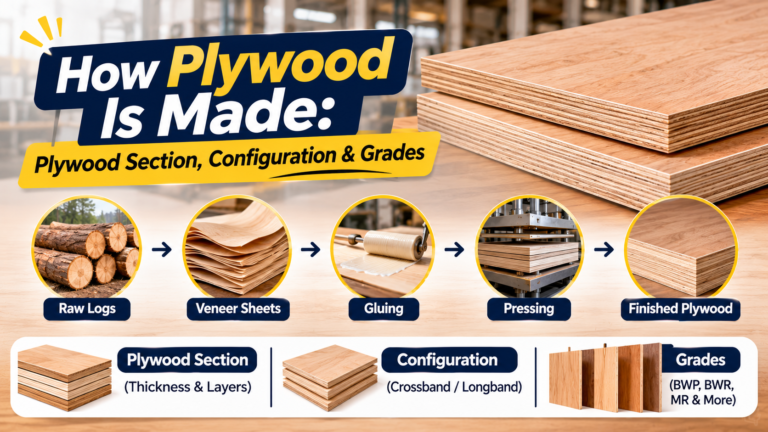
How Plywood Is Made: Plywood Section, Configuration & Grades
Quick answer: How plywood is made involves peeling logs into thin veneer sheets, drying them, and gluing layers together at right angles under heat and pressure. This cross-graining, used in an odd number of plies, gives plywood its strength and stability. Commercial plywood comes in standard 8×4 ft sheets and grades like MR and BWP, each suited to different uses in Indian homes.
If you are studying interior design or planning to renovate your home, understanding plywood is one of the first practical lessons you need. It appears in almost every piece of furniture, wall panelling, and modular kitchen you will ever specify or buy, yet most people never ask how it is actually made.
At Sukriti Professional Academy, we believe knowing your materials is just as important as knowing design theory. Our students get this knowledge first-hand through factory visits and sessions led by experienced faculty, not just textbooks. This blog walks you through how plywood is made, what a plywood section looks like inside, how commercial plywood is configured, and how to tell a good sheet from a poor one before you buy.
By the end, you will understand plywood well enough to make smarter choices for your projects, your clients, or your own home.
What Is Plywood?
Plywood is an engineered wood panel made by gluing together thin layers of wood veneer, with each layer’s grain running perpendicular to the one below it. This cross-grain structure makes plywood stronger, more stable, and less likely to warp than solid wood of the same thickness.
Because of this layered construction, plywood resists shrinking, swelling, and splitting far better than natural timber. That is why it has become the default base material for furniture, cabinets, and panelling across Indian interiors.
What Does a Plywood Section Look Like Inside?
A plywood section refers to the cross-sectional view of the sheet, showing its internal layers, or “plies,” stacked on top of each other. Each ply is a thin veneer sheet, and the number of plies determines the sheet’s thickness and strength.
If you were to cut through a sheet of plywood and look at the edge, you would see these layers clearly, almost like the rings of a tree trunk flattened into stripes. Each layer is glued to the next with its wood grain rotated 90 degrees from the layer beneath it.
Why Does Plywood Always Have an Odd Number of Layers?
Plywood is built with an odd number of layers, typically 3, 5, 7, or more, to keep the sheet balanced and prevent warping. An odd number ensures the grain direction of the outer two face layers runs the same way, which keeps tension equal on both sides of the panel.
If plywood had an even number of layers, the outer surfaces would have grains running in different directions. This imbalance would cause the sheet to twist or bow over time, especially with changes in humidity. The odd-ply structure also means there is always a central core layer, which adds dimensional stability to the entire plywood section.
What Is the Standard Commercial Plywood Configuration?
Commercial plywood configuration in India typically follows a standard 8×4 ft sheet size, with thicknesses ranging from 4mm to 25mm and ply counts that increase with thickness. A thin 4mm sheet may have just 3 plies, while a 19mm or 25mm sheet can have 11 to 15 plies or more.
This 8×4 ft (2440mm x 1220mm) size is considered standard across Indian manufacturers because it matches common furniture and cabinetry dimensions, reducing cutting waste. Within this standard commercial plywood configuration, the common thicknesses used in interiors are:
- 4mm to 6mm: Used for backing panels, drawer bottoms, and decorative overlays.
- 8mm to 12mm: Common for cabinet shutters, partitions, and lightweight furniture.
- 16mm to 19mm: The most widely used thickness for modular kitchens, wardrobes, and structural furniture.
- 25mm: Used for heavy-duty applications like flooring bases and load-bearing furniture.
As a general rule, the thicker the sheet, the more plies it contains, which directly improves its strength and resistance to bending.
What Are the Commercial Plywood Details: MR, BWR, and BWP Grades?
Commercial plywood is graded by its glue bonding type and moisture resistance, with MR (Moisture Resistant), BWR (Boiling Water Resistant), and BWP (Boiling Water Proof, also called marine plywood) being the three main categories used in India. These grades are governed by Indian Standards IS 303 and IS 710.
MR grade plywood uses urea-formaldehyde resin and can withstand some humidity but is not suitable for direct water contact. It is commonly used for interior furniture in dry areas like bedrooms and living rooms. BWR grade plywood uses phenol-formaldehyde resin, giving it better resistance to moisture and making it suitable for kitchens and semi-humid areas. BWP marine plywood is manufactured under IS 710 and is designed to withstand prolonged exposure to water, making it the preferred choice for bathrooms, kitchens, and outdoor-facing furniture.
MR vs BWR vs BWP Plywood: Comparison Table
| Feature | MR Grade | BWR Grade | BWP (Marine) Grade |
|---|---|---|---|
| Full Form | Moisture Resistant | Boiling Water Resistant | Boiling Water Proof |
| Governing Standard | IS 303 | IS 303 | IS 710 |
| Glue Used | Urea-formaldehyde | Phenol-formaldehyde | Phenol-formaldehyde (higher grade) |
| Water Resistance | Low to moderate | Moderate to high | Very high |
| Best Suited For | Bedrooms, living rooms, dry furniture | Kitchens, semi-humid areas | Bathrooms, kitchens, outdoor-facing units |
| Relative Cost | Lowest | Moderate | Highest |
Choose MR grade plywood if you are working on dry interior furniture and want to keep costs down. Choose BWP marine plywood if the furniture will face regular moisture, such as in kitchens or bathrooms, since the extra cost pays off in durability.
How Is Plywood Made? The Plywood Manufacturing Process Step-by-Step
The plywood manufacturing process involves selecting suitable logs, peeling them into veneer sheets, drying the veneers, arranging and gluing the layers, and pressing them under heat before trimming and finishing. Here is how plywood is made, step by step:
- Log Selection: Manufacturers select logs based on species, diameter, and straightness. Common species used in Indian plywood include poplar, eucalyptus, and gurjan.
- Peeling Veneers: Logs are mounted on a rotary lathe and peeled into continuous thin sheets of veneer, much like unrolling a roll of paper from a log.
- Drying: The freshly peeled veneers contain high moisture content and are passed through industrial dryers to reduce moisture to a controlled level, preventing future warping or fungal growth.
- Core Composing: Dried veneer sheets are sorted by quality and arranged in layers, with each layer’s grain rotated 90 degrees to the one beneath it, building up the odd-ply plywood section.
- Glue Spreading: Adhesive, usually urea-formaldehyde or phenol-formaldehyde resin depending on the grade, is applied evenly across each veneer layer before assembly.
- Pressing: The glued layers are stacked and placed into a hot press, which applies heat and pressure to bond the plies into a single solid sheet.
- Trimming: Once pressed, the raw plywood sheet is trimmed at the edges to achieve the standard commercial plywood configuration size, typically 8×4 ft.
- Sanding: The surface is sanded smooth to prepare it for lamination, veneering, or painting.
- Quality Testing: Finished sheets undergo testing for bonding strength, moisture resistance, and overall quality before being graded and dispatched.
Understanding how plywood is made this way helps interior design students appreciate why pricing, strength, and finish vary so much between brands and grades.
Plywood vs Block Board vs MDF: Which Should You Choose?
Plywood, block board, and MDF (Medium Density Fibreboard) are the three most common engineered wood panels used in Indian interiors, and each suits different applications based on strength, cost, and finish requirements.
Plywood is made from thin veneer layers and offers the best overall strength and screw-holding capacity. Block board uses a core of solid wood strips sandwiched between veneer sheets, making it lighter and more economical for larger flat surfaces like shelves and tabletops. MDF is made from compressed wood fibres and resin, offering a smoother surface ideal for painted or laminated finishes but with lower moisture resistance and screw-holding strength compared to plywood.
Plywood vs Block Board vs MDF: Comparison Table
| Feature | Plywood | Block Board | MDF |
|---|---|---|---|
| Core Material | Veneer layers | Solid wood strips + veneer | Compressed wood fibres |
| Strength | High | Moderate to high | Moderate |
| Weight | Moderate | Lighter | Heavier |
| Moisture Resistance | High (grade dependent) | Moderate | Low |
| Screw-Holding Capacity | Excellent | Good | Fair |
| Best Finish For | Veneer, laminate | Laminate, veneer | Paint, laminate |
| Common Use | Cabinets, kitchens, wardrobes | Shelves, large tabletops | Painted furniture, false ceilings |
Choose plywood if durability and moisture resistance matter most. Choose block board if you need a lighter, budget-friendly option for large flat surfaces. Choose MDF if you want a smooth, paint-ready finish and moisture is not a concern.
Where Is Plywood Used in Interiors?
Plywood is used extensively across Indian interiors for applications that need strength, durability, and a stable base for finishing materials. Common uses include:
- Modular kitchens: Carcasses and shutters, typically using BWP marine plywood for moisture resistance.
- Wardrobes and cabinets: Both carcass and shutter panels, often in 16mm to 19mm MR or BWR grade.
- Wall panelling: Decorative and acoustic panelling using thinner plywood sheets.
- False ceilings: Lightweight plywood used as a base before finishing.
- Doors: Flush doors constructed using plywood skins over a block board or hollow core.
- Furniture: Beds, study tables, and shelving units built using plywood for its strength and screw-holding ability.
How Can You Check Plywood Quality Before Buying?
You can check plywood quality before buying by examining the edges for visible gaps, checking for the ISI mark, testing for warping, and verifying the grade matches your intended use. Here is what to look for:
- Check the plywood section on the edge: Look for uniform layers without visible gaps, voids, or overlapping veneers.
- Look for the ISI mark: This indicates the sheet complies with IS 303 or IS 710 standards, depending on the grade.
- Smell and inspect the glue line: A strong chemical smell may indicate poor-quality or excess adhesive.
- Check for warping: Hold the sheet up and sight along its length to check it lies flat without bowing.
- Tap test: A solid, consistent sound when tapped suggests fewer internal voids, while a hollow or inconsistent sound may indicate defects.
- Verify the grade for your application: Confirm MR, BWR, or BWP grade matches where the plywood will be used, especially in kitchens and bathrooms.
Buying from a reputed brand and asking for the test certificate is always a safer bet than going purely on price.
Build Real Material Knowledge, Not Just Theory
Knowing how plywood is made gives you a real advantage, whether you are a student preparing for a design career or a homeowner planning a renovation. From the layered plywood section to commercial plywood configuration and grading under IS 303 and IS 710, every detail affects how your furniture performs over the years.
At Sukriti Professional Academy, our interior design programs are built around this kind of hands-on material knowledge. Our experienced faculty take students on factory visits where they see the plywood manufacturing process in person, rather than only reading about it. This practical exposure is what sets our graduates apart when they enter the industry.
If you want to build a career where you understand materials as well as design, book a free career counselling session at sukritiedu.com or call +91 87459 66777 today.
Frequently Asked Questions
What is the difference between MR grade and BWP marine plywood?
Why does plywood always have an odd number of layers?
What is the standard size of commercial plywood in India?
Is plywood better than MDF for kitchen cabinets?
Yes, plywood is generally better than MDF for kitchen cabinets because it offers higher moisture resistance and stronger screw-holding capacity, both important in humid kitchen environments.
How can I verify plywood quality before purchasing?
Check for the ISI mark, inspect the plywood section for uniform layers without gaps, confirm the grade (MR, BWR, or BWP) suits your application, and ask the seller for test certificates confirming compliance with IS 303 or IS 710.

Interior Design Course Fees in India (2027): Diploma vs Degree vs Short-Term Quick answer: Interior design course fees in India range from …
How Flush Door Is Made: Section, Configuration & Details Quick answer: A flush door is made by building a solid or hollow …
How Plywood Is Made: Plywood Section, Configuration & Grades Quick answer: How plywood is made involves peeling logs into thin veneer sheets, …
How Block Board Is Made: From Core Strips to Commercial Panels Quick answer: Block board is manufactured by sandwiching strips of softwood …







2 Responses