
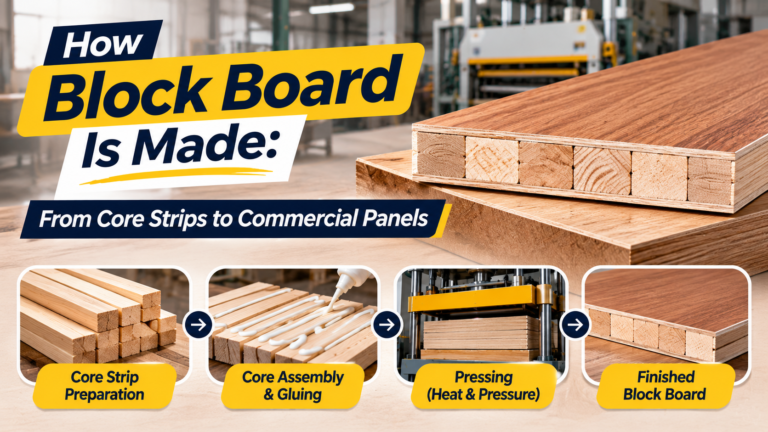
How Block Board Is Made: From Core Strips to Commercial Panels
Quick answer: Block board is manufactured by sandwiching strips of softwood (typically 25–30mm wide) between two or more veneer layers, bonded under heat and pressure with adhesive. This block board manufacturing process creates a panel that resists warping better than plywood while remaining lighter than solid wood, making it a popular choice for furniture, doors, and commercial board configuration in construction projects.
If you’ve ever wondered why some furniture panels feel sturdy yet surprisingly light, the answer often lies in block board. Unlike plywood, which relies entirely on thin layers of veneer, block board uses a core of solid wood strips glued edge to edge, then wraps that core in veneer sheets. This construction gives block board a unique balance of strength, stability, and weight that makes it a staple material across furniture making, interior design, and commercial construction.
Understanding how block board is made helps you make smarter decisions when sourcing material for a project, whether you’re building wardrobes, flush doors, or partition walls. This guide breaks down the entire block board manufacturing process, explains the role of the block board section in determining panel quality, and covers the details that matter most when evaluating commercial board configuration options.
What Is Block Board, and How Does It Differ From Plywood?
Block board is an engineered wood panel made from a core of wooden strips, typically 25mm to 30mm wide, arranged edge to edge and sandwiched between veneer sheets on both faces. The core strips run in one direction, and the veneer layers on top and bottom are glued with their grain running perpendicular to the core strips. This cross-grain structure is what gives block board its dimensional stability.
Plywood, by contrast, is built entirely from thin wood veneers stacked in alternating grain directions. While plywood is strong and uniform, it tends to be heavier for equivalent thickness and can be more expensive depending on the number of veneer layers used. Block board uses less raw veneer material since the core is solid wood strips rather than multiple thin layers, which often makes it a more economical option for applications where screw-holding strength and resistance to bending matter more than surface uniformity.
Choose block board if you need a panel that resists sagging over long, unsupported spans, such as shelving or table tops. Choose plywood if you need a material with a more consistent surface finish for high-end veneering or lamination work. For many furniture makers, the decision comes down to the specific application: block board for structural furniture components, plywood for decorative or curved panel work.
What Is the Block Board Manufacturing Process?
The block board manufacturing process involves several distinct stages, each of which affects the final strength and finish of the panel. Here’s how a typical production run unfolds.
Step 1: Sourcing and Preparing the Core Wood
Manufacturers begin by selecting softwood timber, commonly species like pine, poplar, or other fast-growing, low-density woods. These woods are chosen because they’re lightweight, cost-effective, and easy to cut into uniform strips without excessive waste. The timber is kiln-dried to reduce moisture content, which is critical because wood with high moisture content can warp or shrink after the panel is assembled.
Once dried, the timber is cut into strips. The width of these strips typically ranges from 25mm to 30mm, though some commercial board configuration standards allow for strips up to 50mm depending on the intended panel grade.
Step 2: Arranging the Core Strips Into the Block Board Section
This stage defines what’s known as the block board section — the internal cross-sectional structure of the panel. The wood strips are laid edge to edge, either glued together directly or sometimes left unglued and held in place purely by the surrounding veneer layers, depending on the manufacturer’s process.
The orientation and spacing of these strips matter significantly. Tightly packed, uniformly sized strips create a denser, stronger core, while gaps or inconsistent strip widths can lead to weak points that compromise load-bearing capacity. This is why the block board section is often the first thing inspected when assessing panel quality — a cross-section cut from the edge of the board reveals how consistent and well-bonded the core strips are.
Step 3: Applying Veneer Layers
Once the core is assembled, thin veneer sheets are applied to both faces. These veneers typically run perpendicular to the direction of the core strips, which helps distribute stress across the panel and prevents the core strips from splitting apart under pressure. Depending on the commercial board configuration being produced, manufacturers may use a single veneer layer on each face for standard-grade panels, or multiple cross-banded veneer layers for higher-strength or marine-grade variants.
Step 4: Gluing and Pressing
Adhesive, commonly phenol-formaldehyde or urea-formaldehyde resin depending on whether the board is intended for interior or exterior/moisture-resistant use, is applied between the core and veneer layers. The assembled panel is then placed into a hot press, where heat and pressure cure the adhesive and bond all layers into a single rigid panel.
Pressing time and temperature are closely controlled. Too little pressure or heat results in weak bonding and delamination risk; too much can scorch the veneer or over-cure the adhesive, making the panel brittle.
Step 5: Trimming, Sanding, and Grading
What Commercial Board Configuration Options Are Available?
Commercial board configuration refers to the standardized specifications manufacturers and suppliers use to classify block board for different end uses. Buyers evaluating commercial board configuration should consider the following variables:
Thickness
Grade
Board grades typically fall into categories such as commercial grade (for general interior use) and marine or boiling water resistant (BWR) grade (for high-moisture environments like kitchens or bathrooms). The adhesive type used during manufacturing determines which grade a panel qualifies for — BWR grade boards use water-resistant phenolic resin, while commercial grade panels often use urea-formaldehyde adhesive, which is more cost-effective but less moisture-tolerant.
Core Density
Some commercial board configuration standards distinguish between standard-density and high-density cores. High-density cores use tightly packed, often hardwood strips for applications requiring greater screw-holding strength, such as cabinet hinges or heavy shelving brackets.
Face Veneer Quality
Boards intended for direct painting or laminate application typically use lower-grade face veneers, while boards meant for natural wood finishes use higher-grade veneer selected for consistent grain and minimal visible defects.
Choose a BWR-grade, high-density block board configuration if your project involves kitchen cabinetry or bathroom fittings where moisture exposure is a daily concern. Choose a standard commercial-grade panel with urea-formaldehyde adhesive if you’re working on dry-area furniture like bedroom wardrobes or living room cabinets, where cost efficiency matters more than moisture resistance.
What Details Matter Most When Evaluating Block Board Quality?
Beyond the manufacturing process itself, a few practical details help buyers assess whether a given block board panel meets their project needs:
- Core strip consistency: Inspect the cut edge of the panel. Uniform, tightly packed strips with no visible gaps indicate a well-manufactured block board section.
- Edge bonding: Check whether core strips are glued to each other or simply held by the veneer. Glued strips generally provide better long-term stability.
- Veneer adhesion: Press firmly on the surface to check for any give or hollow sound, which can indicate delamination between the veneer and core.
- Moisture rating: Confirm the adhesive type matches your intended use environment — this single detail prevents costly failures in humid or wet conditions.
- Surface finish grade: Match the veneer grade to your finishing plans; don’t pay for premium veneer if the panel will be laminated or painted over.
Making the Right Choice for Your Next Project
Block board earns its place in furniture and construction projects because of how it’s built: solid wood core strips for strength, cross-grain veneer for stability, and a manufacturing process engineered to balance weight with durability. Understanding the block board section and how commercial board configuration standards vary by thickness, grade, and core density puts you in a stronger position to choose the right panel rather than guessing based on price alone.
Before your next purchase, ask your supplier about adhesive type, core density, and veneer grade. These three details, more than any marketing label, determine how well a block board panel will perform in your specific application.
Frequently Asked Questions
What is block board used for?
How is block board different from plywood?
Block board uses a core of solid wood strips sandwiched between veneer layers, while plywood is built entirely from thin, alternating veneer layers. Block board tends to be lighter and more cost-effective, while plywood offers a more uniform surface for decorative finishes.
Is block board waterproof?
Block board itself isn’t inherently waterproof; its moisture resistance depends on the adhesive used. BWR (boiling water resistant) grade block board uses phenolic resin and tolerates moisture far better than standard commercial-grade board bonded with urea-formaldehyde adhesive.
What thickness of block board should I choose?
Thickness depends on the application. 19mm is a common choice for furniture panels and door cores, while thinner boards (12mm) suit cabinet backs, and thicker boards (25mm) work well for structural partitions.
Does the core strip width affect block board quality?
How Block Board Is Made: From Core Strips to Commercial Panels Quick answer: Block board is manufactured by sandwiching strips of softwood …

Interior Designer vs Interior Decorator: What’s the Real Difference? Quick answer: An interior designer plans the structural layout of a space, handles …

Interior Designer Salary in India: Freshers to Experienced Quick answer: Interior designer salary in India ranges from ₹2.5–4 LPA for freshers to …
Gypsum vs POP False Ceiling: Cost, Durability, Key Differences Quick answer: Gypsum board ceilings use factory-made panels fixed to a metal frame, …