
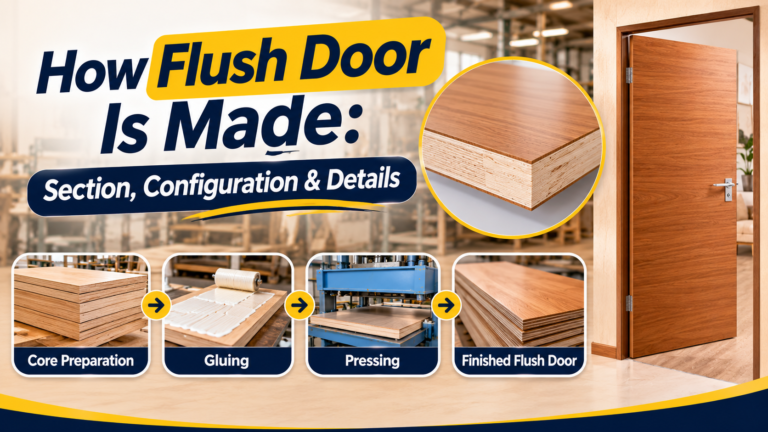
How Flush Door Is Made: Section, Configuration & Details
Quick answer: A flush door is made by building a solid or hollow wooden frame, filling the core with timber blocks or honeycomb material, pasting cross-bands and face veneers on both sides, and hot-pressing everything together under heat and pressure. The door is then trimmed, sanded, edge-finished, and quality-tested before it reaches the market.
If you’re an interior design student or a homeowner planning a renovation, you’ve probably come across flush doors without really knowing what goes into making one. They look simple — flat, smooth, and uniform — but the manufacturing process behind them is surprisingly detailed. Knowing how flush door is made helps you make smarter choices when selecting doors for a project, and it’s also a fundamental topic for anyone studying interior design or carpentry.
At Sukriti Professional Academy, we believe that understanding materials and manufacturing processes is just as important as learning design theory. This guide breaks down flush door sections, configurations, and details, then walks you through the entire flush door manufacturing process step by step. By the end, you’ll understand the difference between a solid core flush door and a hollow core flush door, know what to check before buying, and be able to explain why flush doors remain one of the most popular choices in Indian homes and offices.
What Is a Flush Door?
A flush door is a flat, smooth door with no panels, grooves, or raised designs on its surface. It’s built using a wooden or engineered core sandwiched between layers of veneer or laminate, giving it a clean, uniform appearance on both sides.
Flush doors are popular precisely because of this simplicity. They’re easy to manufacture at scale, cost-effective compared to panel doors, and versatile enough to fit modern, minimalist interiors as well as traditional spaces. Whether it’s a bedroom door, a bathroom door, or an office partition door, flush doors adapt well to nearly every setting.
Flush Door Section: What's Inside
To understand how flush door is made, you first need to understand what’s inside one. A flush door section — meaning a cross-sectional view of the door — typically reveals five main components.
Frame (Stiles and Rails)
Lock Block
A lock block is a solid, reinforced section of timber placed vertically within the door, usually on the side where the lock or handle will be installed. Without a lock block, the core material around the lock area could crumble or weaken over time from repeated use. This component is essential for durability, especially in high-traffic doors.
Core
The core is the heart of the flush door and determines much of its weight, strength, and sound insulation. Depending on the type of flush door, the core could be solid (made from timber blocks, particle board, or similar material) or hollow (made from a honeycomb paper or cardboard structure with a wooden frame).
Cross-Band
Face Veneer
Flush Door Configuration: Standard Sizes and Thickness
Flush door configuration refers to the standard dimensions and thicknesses used across the Indian construction and interior design industry. While custom sizes are always possible, most manufacturers and architects work within a set of commonly accepted measurements for consistency and ease of installation.
In India, standard door heights typically range between 6’6″ (1980mm) and 7’0″ (2135mm), while widths vary depending on usage — single doors for bedrooms and bathrooms are generally narrower, while main entrance doors tend to be wider.
Flush doors are commonly manufactured in three thicknesses:
- 30mm: Lighter doors, often used for internal partitions or low-traffic areas.
- 32mm: The most widely used thickness for residential interior doors, offering a good balance of strength and weight.
- 35mm: Heavier doors used for main entrances or areas requiring additional durability and sound insulation.
Choosing the right flush door configuration depends on the door’s intended location. Interior design students should note that main doors typically call for thicker, solid core options, while internal doors can often use thinner, lighter configurations without compromising function.
Flush Door Details: Solid Core vs Hollow Core
One of the most important flush door details to understand is the difference between solid core and hollow core construction. This distinction affects weight, soundproofing, cost, and suitability for different applications.
A solid core flush door is filled with timber blocks, particle board, or similar dense material throughout the core. This makes it heavier, more durable, and better at sound insulation, which is why solid core flush doors are commonly recommended for main entrances, bedrooms, and areas needing privacy.
A hollow core flush door uses a honeycomb paper or cardboard structure inside a wooden frame, leaving most of the interior empty aside from the supporting structure. This makes the door significantly lighter and more affordable, making it a practical option for low-traffic internal doors like store rooms or wardrobes.
Flush doors are also categorized by grade under IS 2202 (the Indian Standard for flush door specifications), which outlines quality parameters for solid core and hollow core construction. Choose a solid core flush door if sound insulation, durability, and security matter more than cost; choose a hollow core flush door if affordability and lighter weight are the priority.
| Feature | Solid Core Flush Door | Hollow Core Flush Door |
|---|---|---|
| Core material | Timber blocks/particle board | Honeycomb paper/cardboard |
| Weight | Heavier | Lighter |
| Sound insulation | Better | Limited |
| Durability | Higher | Moderate |
| Cost | Higher | Lower |
| Best use | Main doors, bedrooms | Internal/low-traffic doors |
How Flush Door Is Made: Step-by-Step Manufacturing Process
Now that you understand the flush door section and configuration, here’s how flush door is made from raw timber to the finished product. The flush door manufacturing process generally follows these steps:
- Timber Seasoning: Raw timber is seasoned (dried) to reduce moisture content, which prevents warping, cracking, or shrinkage after the door is installed.
- Frame Making: Seasoned timber is cut and joined to form the stiles, rails, and lock block, creating the door’s structural frame.
- Core Filling: Depending on whether it’s a solid core or hollow core flush door, the frame is filled with timber blocks, particle board, or a honeycomb structure.
- Veneer Pasting: Cross-band veneer is applied over the core, followed by the face veneer on both sides, using adhesive to bond each layer securely.
- Hot Pressing: The assembled door is placed in a hydraulic hot press, which applies heat and pressure to bond all the layers into a single, solid unit.
- Trimming: Excess material along the edges is trimmed to achieve the final, precise dimensions of the door.
- Sanding: The surface is sanded smooth to remove any imperfections and prepare it for finishing.
- Edge Finishing: The edges are finished (often with edge banding or lipping) to protect against moisture and give a clean, complete look.
- Quality Testing: The finished door undergoes testing for strength, moisture resistance, and dimensional accuracy before it’s approved for sale.
According to Sukriti Professional Academy’s faculty, who regularly take students on factory visits as part of the curriculum, observing this process firsthand helps students understand why quality control at each stage — particularly timber seasoning and hot pressing — has such a significant impact on the final door’s performance and lifespan.
Flush Door vs Panel Door: What's the Difference?
Flush doors and panel doors differ primarily in construction and appearance. A flush door has a flat, smooth surface with an internal core, while a panel door is built from multiple wooden panels fitted into a frame, often with decorative grooves or raised designs.
Flush doors are generally lighter, more affordable, and easier to manufacture in bulk, making them common in modern residential and commercial projects. Panel doors, on the other hand, carry a more traditional or ornamental look and tend to cost more due to the additional joinery and detailing involved. For homeowners wanting a minimalist, contemporary interior, flush doors are usually the better fit; for those seeking a classic or heritage aesthetic, panel doors may be worth the extra investment.
Where to Use Flush Doors in Homes and Offices
Flush doors are versatile enough to work across nearly every room and setting, but certain configurations work better for specific uses:
- Main entrance doors: Solid core flush doors with 35mm thickness, for strength and security.
- Bedroom doors: Solid core flush doors with 32mm thickness, for privacy and sound insulation.
- Bathroom doors: Flush doors with moisture-resistant treatment, given the higher humidity exposure.
- Office partition doors: Hollow core flush doors, since sound insulation needs are typically lower and cost-efficiency matters more.
- Store rooms and wardrobes: Hollow core flush doors, since these areas see low traffic and don’t need heavy-duty doors.
How to Check Flush Door Quality Before Buying
Before purchasing a flush door, it’s worth inspecting a few key details to avoid ending up with a poor-quality product:
- Check the edges: Look for visible gaps, uneven trimming, or exposed core material along the edges.
- Tap the surface: A solid core flush door should sound dense and solid when tapped, while a hollow core door will sound noticeably hollow.
- Inspect the veneer: The face veneer should be smooth, free of bubbles, and consistent in color and grain across the surface.
- Ask about IS 2202 compliance: Reputable manufacturers will confirm whether their flush doors meet IS 2202 grading standards.
- Check the weight: A heavier door generally indicates a solid core, which is preferable for main doors and high-traffic areas.
Why Understanding Flush Door Manufacturing Matters for Your Career
Knowing how flush door is made isn’t just useful trivia — it’s practical knowledge that separates confident interior designers from those who simply pick materials off a catalogue. Understanding flush door sections, configurations, and details allows you to recommend the right door for the right application, explain your choices to clients with authority, and avoid costly mistakes during execution.
At Sukriti Professional Academy, our interior design courses go beyond classroom theory. Our experienced faculty take students on factory visits where they see materials like flush doors being manufactured firsthand, building the kind of practical knowledge that employers in Delhi’s interior design industry actively look for.
If you’re serious about building a career in interior design, understanding materials like flush doors is just the beginning. Book your free career counselling session at sukritiedu.com or call +91 87459 66777 to learn more about our courses.
Frequently Asked Questions
What is the standard thickness of a flush door in India?
Flush doors in India are commonly available in 30mm, 32mm, and 35mm thicknesses, with 32mm being the most widely used for residential interior doors.
What is the difference between solid core and hollow core flush doors?
A solid core flush door is filled with timber blocks or particle board, making it heavier and better for sound insulation, while a hollow core flush door uses a honeycomb structure, making it lighter and more affordable.
Which is better for a main door — solid core or hollow core?
A solid core flush door is better for main doors because it offers greater strength, security, and sound insulation compared to a hollow core option.
What does IS 2202 mean for flush doors?
IS 2202 is the Indian Standard that outlines quality and grading specifications for flush door construction, covering both solid core and hollow core types.
How can I tell if a flush door is good quality before buying?
Check the edges for gaps, tap the surface to judge core density, inspect the veneer for smoothness, and confirm IS 2202 compliance with the manufacturer.

Interior Design Course Fees in India (2027): Diploma vs Degree vs Short-Term Quick answer: Interior design course fees in India range from …
How Flush Door Is Made: Section, Configuration & Details Quick answer: A flush door is made by building a solid or hollow …
How Plywood Is Made: Plywood Section, Configuration & Grades Quick answer: How plywood is made involves peeling logs into thin veneer sheets, …
How Block Board Is Made: From Core Strips to Commercial Panels Quick answer: Block board is manufactured by sandwiching strips of softwood …







One Response