
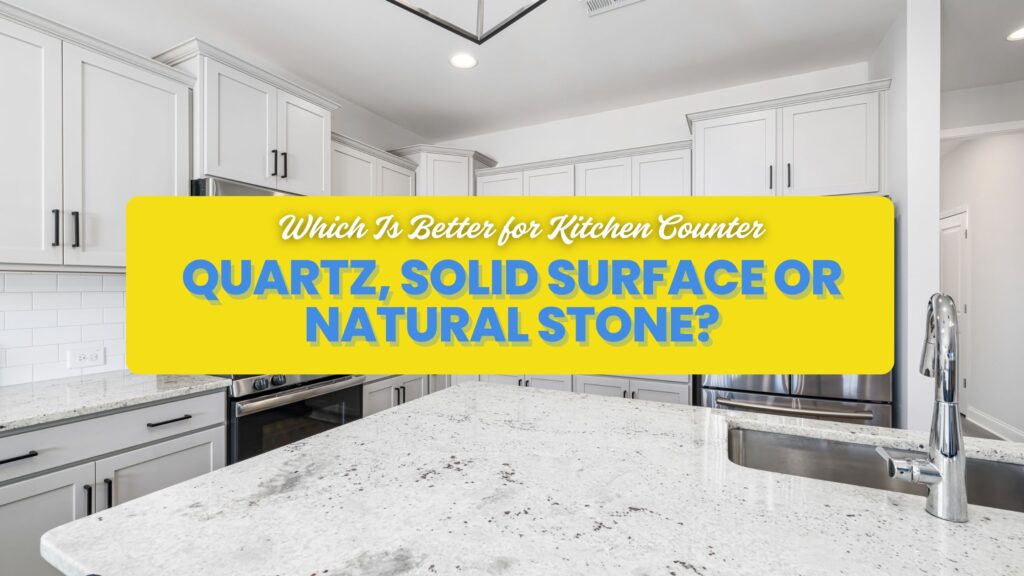
Which Is Better for Kitchen Countertops: Quartz, Solid Surface, or Natural Stone?
The kitchen is the engine room of the home. It’s where science meets art, where messes are made, and where memories are cooked up. But underneath all that activity is one critical component that takes a beating every single day: your countertop.
Choosing a surface isn’t just about picking a color that matches your cabinets. It is a decision about how you live. Will you panic if a guest spills red wine? Do you chop vegetables directly on the surface (please don’t, but we know it happens)? Are you looking for something that will survive three teenagers making sandwiches, or a showpiece for a quiet, modern apartment?
If you are struggling to decide which is better for kitchen counter applications, you aren’t alone. The debate usually narrows down to the big three: Quartz, Solid Surface, and Natural Stone. As a designer, I’ve walked hundreds of clients through this decision. Let’s break down the noise and find the right surface for your lifestyle.
Understanding Kitchen Countertop Requirements
Before we dive into materials, we need to establish the criteria. A kitchen countertop isn’t a museum piece; it’s a workspace. When evaluating materials, we look at four main “stress tests”:
- Hygiene: Is the surface porous? Does it trap bacteria from raw meat or spills? Heat Tolerance: Can it handle a hot pasta pot, or will it scorch?
- Stain Resistance: How does it react to the “acid test”—lemon juice, tomato sauce, and wine?
- Impact Durability: Will it chip if a heavy cast-iron skillet slips from your grip?
Every material has a weakness. The goal is to find the one whose weakness you can live with.
Quartz Countertops: The Engineered Powerhouse
Quartz has surged in popularity over the last two decades, becoming the go-to standard for many renovations. But what is it, really? It is an engineered stone product, typically made of 90-93% ground natural quartz aggregates mixed with polymer resins and pigments.
Features and Benefits:
The biggest selling point of quartz vs natural stone countertops is consistency. Because it is manufactured, the slab you see in the showroom is exactly what arrives at your home. It is non-porous, meaning it doesn’t need sealing—ever. It resists staining incredibly well because liquids can’t penetrate the surface.
Limitations:
Quartz is tough, but it isn’t invincible. The resin that binds the stone together is plastic-based, which means it is sensitive to high heat. Placing a hot roasting pan directly on quartz can leave a permanent burn mark or discoloration. Also, while it resists scratching, chipped edges are hard to repair seamlessly.
Solid Surface Countertops: The Seamless Sculptor
Solid surface (commonly known by the brand name Corian) is a synthetic material made of acrylic or polyester resins and mineral fillers. Think of it as a high-end, stone-like plastic.
Features and Benefits:
The magic of a solid surface is in the seams—or rather, the lack of them. When installed, joints are glued and sanded to be virtually invisible. This allows for integrated sinks where the counter flows right into the basin with no lip to catch grime. It is also renewable. If you scratch it, you can literally sand the scratch out with a Scotch-Brite pad.
Limitations:
When comparing quartz vs solid surface kitchen applications, solid surface is much softer. It scratches easily (though, as mentioned, is repairable). It is also the least heat-resistant of the three options. A hot pot will melt or scorch it instantly. It lacks the depth and “cold” feel of stone, which some homeowners find less premium.
Natural Stone Countertops: The Earth's Art
This category includes Granite, Marble, Soapstone, and Quartzite. These are quarried directly from the earth, cut into slabs, and polished. No two pieces are alike.
Features and Benefits:
There is a depth to natural stone that man-made materials just can’t replicate. Granite is incredibly hard and heat resistant. You can often set a hot pan on granite without issue (though trivets are still recommended). Marble offers a classic, luxurious aesthetic that defines high-end design.
Limitations:
The main drawback of solid surface vs natural stone is porosity. Natural stone is like a hard sponge. If you don’t seal it regularly (usually once a year), it will absorb oils, wine, and juices, leading to permanent stains. Marble, in particular, is soft and reacts with acids; a squeeze of lemon can “etch” a dull spot into the polished finish permanently.
Comparison Table: Quartz vs Solid Surface vs Natural Stone
To visualize how these contenders stack up, here is a direct comparison based on key performance metrics.
Feature | Quartz (Engineered) | Solid Surface (Acrylic) | Natural Stone (Granite/Marble) |
Durability (Impact) | Very High | Moderate (can dent) | High (Granite) / Moderate (Marble) |
Scratch Resistance | High | Low (scratches easily) | High (Granite) / Low (Marble) |
Heat Resistance | Moderate (resin can burn) | Low (prone to melting) | High (naturally heat resistant) |
Stain Resistance | Excellent (non-porous) | Good (stains can be sanded out) | Varies (needs sealing to resist stains) |
Maintenance | Low (soap & water) | Low (sanding required for repairs) | Moderate to High (requires sealing) |
Hygiene | Excellent (non-porous) | Excellent (seamless & non-porous) | Good (if sealed properly) |
Appearance | Uniform, consistent patterns | Matte/Satin, seamless look | Unique, random natural veining |
Cost | Moderate to High | Moderate | Varies widely by stone |
Best Material for Different Kitchen Needs
1. The Busy Family Kitchen
Winner: Quartz
If you have kids making peanut butter sandwiches, spilling juice, and dropping toys on the counter, quartz is your best bet. It offers the stone look without the anxiety of staining. It handles abuse well and requires zero maintenance beyond wiping it down.
2. The Low-Maintenance Modern Kitchen
Winner: Solid Surface
For a sleek, minimalist aesthetic with absolutely no visible joints, solid surface is unmatched. It is also great if you want a countertop that feels “warm” to the touch and creates a quiet acoustic environment (no clanging when you set down a glass). The ability to sand out minor scratches makes it very forgiving over decades.
3. The Luxury or Baker's Kitchen
Winner: Natural Stone (Specifically Marble or Quartzite)
If you bake pastry, nothing beats the cool surface of real marble for rolling out dough. For high-end luxury homes where uniqueness is paramount, natural stone is the status symbol of choice. Homeowners in this category often accept the “patina” (etching and wear) as part of the stone’s living beauty.
Interior Designer’s Recommendation
When clients ask me to choose between quartz solid surface or natural stone, I usually start with a reality check on their cleaning habits.
I once worked with a client who dreamed of white Carrara marble. She loved the look but admitted she drank red wine frequently and wasn’t great at wiping up spills immediately. I gently steered her toward a high-end engineered quartz that mimicked the marble veining. Three years later, she thanked me—her counters were still pristine white, despite many wine nights.
However, for a different project—a mid-century modern restoration—we used solid surface because we needed a funky, curved island shape that stone simply couldn’t achieve.
My general rule:
- Go with Quartz if you want the “set it and forget it” option.
- Go with Natural Stone if you want art and don’t mind a little maintenance.
- Go with Solid Surface if you need complex shapes or hate cleaning grout/seams.
Common Mistakes People Make While Choosing Kitchen Counters
1. Ignoring the “Sample vs. Slab” Reality
With natural stone, never buy from a small sample. The 4-inch square sample might be white, but the full slab might have a giant black streak through it. Always view the full slab. Quartz is consistent, but natural stone is wild.
2. Overestimating Heat Resistance
People assume “stone” means “fireproof.” Even with granite, thermal shock can crack a cold slab if you place a scorching hot pot on it. Regardless of the material, always budget for some nice trivets.
3. Focusing Only on Price Per Square Foot
Don’t forget fabrication and installation costs. A cheap tile might cost less per foot, but the labor to install it is high. Solid surface and quartz often have simpler pricing structures, but edge profiles and cutouts for sinks can drive the price up significantly.
Final Verdict: Which One Is Better for Your Kitchen?
So, which is better for kitchen counter renovations?
- Choose Quartz if you prioritize durability, hygiene, and resale value, and you want a premium look with zero maintenance.
- Choose Solid Surface if you want a seamless, repairable surface that feels softer to the touch and fits a modern, curvy aesthetic.
- Choose Natural Stone if you want a one-of-a-kind masterpiece and are willing to care for it like the natural element it is.
Your countertop is the stage for your life. Choose the one that handles your script best.
Want to Master the Art of Interiors?
Selecting the right materials is just one piece of the design puzzle. If you found yourself nodding along to the technical details of surfaces and durability, you might have a knack for this industry. Why not take that interest further? Explore professional interior design courses to learn how