
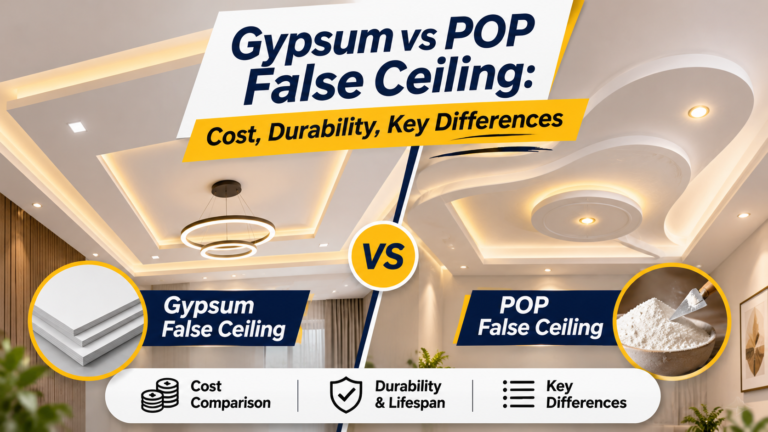
Gypsum vs POP False Ceiling: Cost, Durability, Key Differences
Quick answer: Gypsum board ceilings use factory-made panels fixed to a metal frame, giving faster installation, cleaner site work, and better crack resistance. POP (Plaster of Paris) ceilings are hand-moulded on site, offering more design flexibility for curves and cornices but taking longer to dry and finish. For most Delhi NCR homes, gypsum suits bedrooms and living rooms, while POP works better for ornate false ceiling designs with heavy moulding.
Choosing between a gypsum vs POP false ceiling is one of the first material decisions a homeowner makes once the false ceiling layout is finalised. Both materials have been used across Delhi NCR homes for decades, and both have genuine strengths depending on the room and the design brief. The confusion usually starts when a contractor recommends one without explaining why it suits that particular space.
This guide breaks down what gypsum board ceiling and POP ceiling actually are, how each is installed, and where each one performs best. You will also find realistic cost ranges per square foot, room-by-room recommendations, and a note on ceiling height requirements that many first-time homeowners overlook. Interior design students will find this useful too, since material selection like this comes up constantly in site visits and client briefings.
By the end, you should be able to walk into a site discussion and ask the right questions — instead of simply accepting whatever the contractor proposes.
What are gypsum board ceiling and POP ceiling, and how is each installed?
A gypsum board ceiling is built using prefabricated gypsum panels — factory-made boards made of compressed gypsum plaster sandwiched between paper layers — screwed onto a metal or wooden frame suspended from the original ceiling. The installer measures the room, fixes a grid of GI (galvanised iron) channels to the slab, and then screws gypsum boards directly onto this frame. Joints between boards are taped and filled with jointing compound before painting.
A POP ceiling is built using Plaster of Paris, a powder made from gypsum that is mixed with water on site and applied wet, directly over a wire mesh fixed to the slab or frame. The mason applies the wet plaster in layers, shaping curves, cornices, and decorative patterns by hand before it sets. This wet application process is what gives POP its design flexibility, but it also means the finish depends heavily on the individual mason’s skill.
Gypsum board ceiling installation typically takes 2–4 days for an average room, since the boards arrive pre-cut and ready to fix. POP ceiling installation usually takes longer — often 5–7 days — because each layer of wet plaster needs time to dry before the next step begins.
What are the differences between gypsum and POP false ceilings?
Gypsum and POP false ceilings differ mainly in installation time, site mess, finish quality, crack resistance, moisture behaviour, and ease of repair. Knowing these six differences helps you match the material to your room, your timeline, and your maintenance expectations.
Installation time and site mess
Gypsum board installation is faster and significantly cleaner, since the boards are fixed dry with screws and leave minimal construction debris. POP installation involves mixing wet plaster on site, which creates dust, splashes, and water-related mess that needs daily cleanup during the work.
Finish quality
Crack resistance
Moisture behaviour
Repair and maintenance
A damaged gypsum board panel can be unscrewed and replaced individually without disturbing the rest of the ceiling. Repairing a POP ceiling usually means re-plastering the entire damaged section by hand, which takes longer and requires matching the existing texture.
Weight and structural load
Gypsum boards are considerably lighter than wet-applied POP, which puts less load on the suspension frame and the original ceiling slab. This is one reason gypsum is often preferred for larger rooms or ceilings with false ceiling lighting cutouts, since the frame carries less overall weight.
How much does a false ceiling cost per sq ft in India?
False ceiling cost per sq ft in India depends on the material, the design complexity, and the city, but general ranges hold fairly steady across Delhi NCR. Gypsum board false ceilings typically cost ₹70–₹100 per sq ft for a simple flat design, while POP false ceilings usually cost ₹55–₹85 per sq ft for comparable simple work.
Costs rise sharply for both materials once the design includes multiple levels, cove lighting channels, or decorative moulding. A heavily detailed POP ceiling with cornice work can cost ₹120–₹160 per sq ft, since the labour time increases substantially with design complexity.
Material cost is only part of the total bill — labour charges, the GI frame, jointing compound, and painting all add to the final figure. Always ask your contractor for a room-wise quote that separates material cost from labour, so you can compare estimates accurately across vendors.
Which false ceiling is best for living rooms, bedrooms, kitchens and bathrooms?
Which false ceiling is best for home use depends entirely on the room’s function, moisture exposure, and design ambition. Living rooms often suit POP when the design includes cove lighting and decorative cornices, since this is where homeowners typically want a statement ceiling.
Bedrooms generally work well with gypsum board ceilings, since the flat, clean finish suits a restful space and installation causes less disruption to a room in daily use. Kitchens need careful consideration — moisture-resistant gypsum board is a safer choice than standard gypsum or POP, because routine cooking releases steam that can affect both materials over time.
Bathrooms are the one area where neither standard gypsum nor POP is recommended for direct ceiling use, due to consistent humidity and occasional water exposure. Moisture-resistant gypsum board, specifically rated for wet areas, or PVC false ceiling panels are the safer alternatives for bathroom ceilings.
What is the recommended ceiling drop and minimum room height for a false ceiling?
False ceiling height from floor should be planned before finalising either a gypsum or POP design, since insufficient room height can make a space feel cramped. A false ceiling typically drops the existing slab height by 150mm to 300mm (6 to 12 inches), depending on whether the design includes recessed lighting or ducting.
Rooms with a standard slab height of 9 feet (2.7 metres) can comfortably accommodate a false ceiling drop of around 6 inches without feeling low. Rooms with slab heights below 8.5 feet (2.6 metres) need a more conservative drop — sometimes as little as 4 inches — to avoid a visually heavy, low ceiling.
Designs with cove lighting or multi-level POP work generally need a deeper drop, often 10 to 12 inches, to accommodate the wiring and layered plaster work. Always confirm the required drop with your designer before finalising electrical points, since changing the plan mid-installation adds both cost and delay.
What other false ceiling options are available?
PVC, grid, and wooden false ceilings are the main alternatives to gypsum and POP, each suited to specific rooms and budgets. PVC false ceiling panels are moisture-resistant and budget-friendly, making them a practical choice for bathrooms, balconies, and utility areas.
Grid false ceilings use a metal grid framework with removable tiles, commonly seen in offices and commercial spaces rather than homes, since they allow easy access to wiring and ducting above. Wooden false ceilings offer a warm, natural finish and are often used as accent sections combined with gypsum, though solid wood costs considerably more and needs periodic maintenance against termites and moisture.
Comparison Table: Gypsum vs POP False Ceiling
| Factor | Gypsum Board Ceiling | POP Ceiling |
|---|---|---|
| Installation time | 2–4 days | 5–7 days |
| Site mess | Minimal (dry fixing) | Higher (wet plaster work) |
| Finish flexibility | Flat, modern finishes | Curves, cornices, decorative work |
| Crack resistance | Better, due to taped joints | More prone to hairline cracks over time |
| Moisture resistance | Moderate (better in moisture-resistant variants) | Moderate once cured |
| Repair ease | Easy — replace individual panels | Harder — requires re-plastering |
| Approximate cost per sq ft | ₹70–₹100 | ₹55–₹85 |
| Best suited rooms | Bedrooms, kitchens, modern living rooms | Living rooms with decorative ceilings |
Comparison Table: Other False Ceiling Materials
| Material | Best Use | Key Advantage |
|---|---|---|
| PVC | Bathrooms, balconies, utility areas | Highly moisture-resistant, budget-friendly |
| Grid | Offices, commercial spaces | Easy access to wiring and ducting |
| Wooden | Accent sections, premium living rooms | Warm, natural finish |
Expert Tip from Sukriti Faculty: During client site visits across Delhi NCR, faculty at Sukriti Professional Academy consistently find that homeowners choose a ceiling design before checking the room’s slab height. Always measure the existing slab-to-floor height first — a design that looks stunning in a catalogue can feel oppressive in a room with a low ceiling.
Key Takeaways
- Gypsum board ceilings install faster, create less site mess, and resist cracks better than POP ceilings.
- POP ceilings offer greater design flexibility for curves, cornices, and decorative moulding, at the cost of longer drying time.
- False ceiling cost per sq ft in India generally ranges from ₹55–₹100 for simple designs, rising significantly with decorative complexity.
- Bedrooms and kitchens generally suit gypsum, while statement living room designs often favour POP.
- Always confirm the ceiling drop against your room’s slab height before finalising lighting and electrical points.
Frequently Asked Questions
Is gypsum or POP better for a false ceiling?
What are the disadvantages of a POP ceiling?
How much does a false ceiling cost per sq ft in India?
False ceiling cost per sq ft in India typically ranges from ₹55–₹100 for simple gypsum or POP designs, rising to ₹120–₹160 for heavily detailed cove lighting or cornice work. Always get a room-wise quote separating material and labour before finalising a budget.
Which false ceiling is best for a kitchen?
How much height does a false ceiling take from the floor?
Can gypsum and POP be combined in the same ceiling design?
Yes, many Delhi NCR homes combine a flat gypsum board base with POP cornice detailing around the edges, giving a balance of clean finish and decorative flexibility. This hybrid approach is common in living rooms where homeowners want cove lighting without a fully plastered ceiling.
Why should interior design students learn the gypsum vs POP false ceiling comparison?
Interior design students need to understand the gypsum vs POP false ceiling comparison because material recommendations directly affect a project’s timeline, budget, and client satisfaction. Knowing when to recommend gypsum over POP — and explaining the reasoning to a client — is a core skill taught early in Sukriti Professional Academy’s one-month interior decoration course.
Choosing Between Gypsum and POP False Ceiling the Right Way
Deciding on a gypsum vs POP false ceiling comes down to matching the material to the room’s function, your renovation timeline, and the design complexity you want. Gypsum suits homeowners who want a faster, cleaner installation with a flat modern finish, while POP suits those prioritising decorative detailing over speed.
Getting this decision right the first time saves both money and rework, especially once lighting, wiring, and ceiling height are factored into the plan. If you’re exploring how ceiling choices fit into a wider design direction for your home, Sukriti’s guide to interior design styles from modern to industrial is a useful next read.
Sukriti Professional Academy, led by Dr. Ar. Babita Srivastava with over 25 years of experience in interior design education, offers free career counselling for students exploring interior design across its Kalkaji, Noida Sector 18, and Greater Noida branches. Reach out for a free counselling session to find out which course fits your goals.

Interior Designer Salary in India: Freshers to Experienced Quick answer: Interior designer salary in India ranges from ₹2.5–4 LPA for freshers to …
Gypsum vs POP False Ceiling: Cost, Durability, Key Differences Quick answer: Gypsum board ceilings use factory-made panels fixed to a metal frame, …
MR vs BWR vs BWP Plywood — Which Grade to Use Where? Quick answer: MR (Moisture Resistant) plywood suits dry areas like …

Standard Furniture Dimensions in India: Bed, Sofa, Wardrobe & More Quick answer : Interior Design is an ever exchanging and ever-evolving field. …