
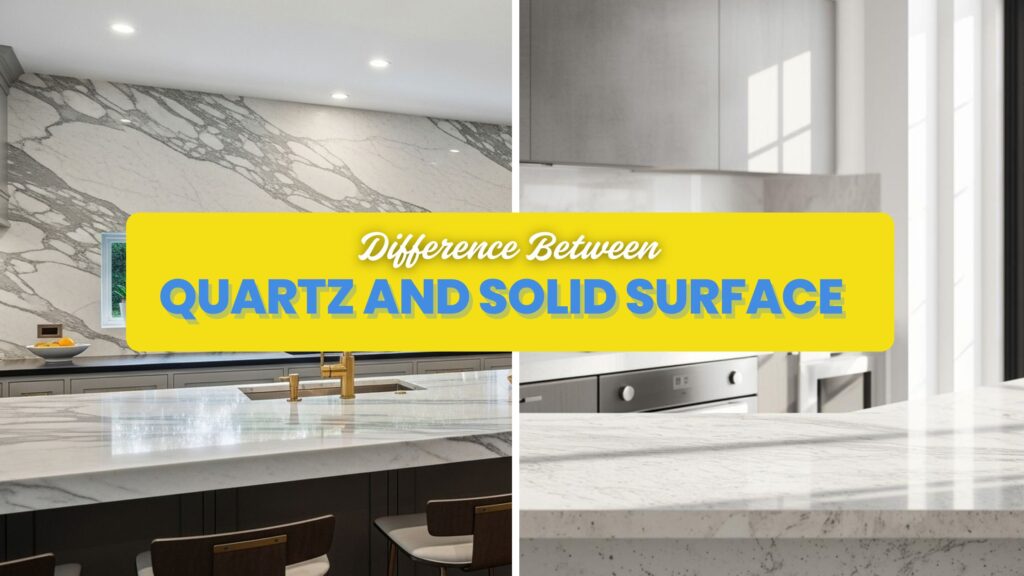
Difference Between Quartz and Solid Surface: Which Material Is Better for Modern Interiors?
If you have ever stood in a showroom, running your hand over twenty different samples of white countertop material, you know the specific kind of fatigue that comes with renovation decisions. Material selection is the backbone of interior design. It isn’t just about what looks good on a mood board; it is about how a home functions for the next ten or fifteen years.
Two materials often dominate the conversation for modern countertops and work surfaces: engineered quartz and solid surface (often known by the brand name Corian). To the untrained eye, a white slab of one might look exactly like the other. However, they are fundamentally different beasts.
Understanding the difference between quartz and solid surface is critical for students, homeowners, and professionals alike. This isn’t just about price; it is about how these materials react to heat, scratches, and your daily life. Let’s dive into the specifics so you can specify or buy with confidence.
What is Quartz?
When we talk about quartz in the industry, we aren’t talking about a solid slab cut directly from a mountain, like granite or marble. We are talking about “engineered stone.”
Quartz surfacing is a composite material. It is typically made of about 90-93% crushed natural quartz crystals mixed with 7-10% resins, polymers, and pigments. This manufacturing process creates a material that is incredibly dense and non-porous.
Appearance and Uses:
Because it is engineered, manufacturers can control the look precisely. You can find quartz that mimics the veining of Calacatta marble almost perfectly, or options that look like industrial concrete. It has a depth and a “sparkle” due to the crushed crystal content. It is heavy, feels cold to the touch like real stone, and is primarily used for kitchen countertops, bathroom vanities, and backsplashes.
What is Solid Surface?
Solid surface is a purely synthetic material. Invented by DuPont in the 1960s (originally branded as Corian), it is made from acrylic or polyester resins mixed with mineral dust (bauxite) and pigments.
Think of it as a very dense, high-quality plastic-stone hybrid. The color and pattern go all the way through the material—hence the name “solid surface.” If you cut it in half, the inside looks exactly like the outside.
Appearance and Uses:
Solid surface has a matte, opaque quality. It doesn’t have the crystalline depth of quartz. However, it feels softer and warmer to the touch. It is incredibly versatile. Because it is essentially a resin, it can be “thermoformed”—heated and bent into curved shapes. You will see solid surface material for interiors used in everything from seamless kitchen counters with integrated sinks to reception desks and medical laboratory surfaces.
Key Differences Between Quartz and Solid Surface
To make the comparison easier, here is a breakdown of how these materials stack up against each other.
Feature | Quartz (Engineered Stone) | Solid Surface (Acrylic/Resin) |
Composition | ~90% Natural Quartz + Resin | Acrylic/Polyester Resin + Mineral filler |
Durability | Extremely hard; resistant to scratches and cuts. | Softer; susceptible to scratches and dents. |
Maintenance | Low maintenance; no sealing required. | Low maintenance; scratches can be sanded out. |
Appearance | Stone-like, glossy or matte, deep visual texture. | Uniform, matte/satin finish, seamless look. |
Heat Resistance | Moderate (resins can discolor), but stone content helps. | Low (hot pans will scorch or melt it). |
Seams | Visible seams (though tight). | Virtually invisible (seamless) joints. |
Cost | High | Moderate to High |
Quartz vs Solid Surface for Kitchen Countertops
The kitchen is the ultimate testing ground. When weighing quartz vs solid surface for kitchen applications, you have to think about your cooking style.
The Heat Factor
If you are the type of cook who pulls a roasting pan out of the oven and sets it on the counter without thinking, both materials have risks, but solid surface is riskier. Solid surface is plastic-based; a hot pot will leave a permanent scorch mark or even melt the surface. Quartz is more heat resistant because of the stone content, but the resin binder can still burn. We always recommend trivets for both, but quartz is more forgiving of accidental heat exposure.
The Scratch Test
Quartz is one of the hardest minerals on earth. If you drag a ceramic bowl across a quartz countertop, the bowl will likely suffer more than the counter. In the battle of quartz countertops vs solid surface, quartz wins on scratch resistance. Solid surface is softer. If you slide a heavy box of groceries across it, you might see fine white scratches appear. However, this leads us to a unique advantage of solid surface: repairability.
Pros and Cons of Quartz
Pros:
- Luxurious Aesthetic: It looks and feels like high-end stone, adding significant resale value to a home.
- Incredible Durability: It is very difficult to chip or scratch under normal use.
- Non-Porous: It resists staining from wine, coffee, and oils better than natural granite.
- Consistency: Unlike natural stone, the sample you see in the store is exactly what your slab will look like.
Cons:
- Visible Seams: If your island is wider than the slab (usually 120 inches), you will have a seam. It will be visible, much like a granite seam.
- Price: It is generally more expensive than solid surface.
- Difficult Repairs: If you manage to chip a quartz edge (perhaps by dropping a heavy cast iron skillet), fixing it requires a professional and it may never look perfect again.
- UV Sensitivity: Darker quartz can fade in direct, harsh sunlight over many years.
Pros and Cons of Solid Surface
Pros:
- Invisible Seams: This is the “killer app” of solid surface. Pieces are glued together with a color-matched adhesive and sanded down. You can have a 20-foot long counter that looks like one single piece.
- Integrated Sinks: You can mold the sink directly into the countertop seamlessly, leaving no rim for grime to collect. This is huge for hygiene.
- Renewable Surface: If you scratch it, you can literally sand the scratch out with a Scotch-Brite pad or orbital sander. It can be refinished to look brand new after 10 years.
- Warmth: It doesn’t suck the heat out of your arms when you lean on it like stone does.
Cons:
- Prone to Damage: It scratches and dents relatively easily compared to stone.
- Heat Sensitivity: It cannot handle high heat.
- Chemical Sensitivity: Strong chemicals (like nail polish remover or paint thinner) can damage the finish.
- “Plastic” Feel: Some homeowners feel it lacks the premium weight and gravity of stone.
Which Material Should You Choose?
Deciding between solid surface vs quartz countertops usually comes down to three factors: budget, geometry, and lifestyle.
Choose Quartz If:
- You want the “Stone” Look: If your design calls for the elegance of marble or granite but you don’t want the maintenance of sealing natural stone.
- You have a heavy-traffic kitchen: If you have kids who might drag toys across the counter or you do heavy cooking, the hardness of quartz is superior.
- Resale Value is a priority: Generally, the real estate market currently places a higher premium on quartz surfaces.
Choose Solid Surface If:
- You hate cleaning grout and seams: If you want a giant island with absolutely no visible joints, solid surface is your only option.
- You want a unique shape: If your design involves curves, rounded edges, or thermoformed backsplashes, solid surface is the flexible medium you need.
- You are designing for healthcare or intense hygiene: The integrated sinks and seamless nature make it the antibacterial champion.
- You are budget-conscious but want quality: While high-end solid surface can rival quartz prices, mid-range options are often more affordable.
Interior Designer’s Perspective
As a designer, I look at quartz vs solid surface not just as “Better or Worse,” but “Right or Wrong for the Space.”
Here is a practical scenario: I recently designed a modern, minimalist kitchen with a massive, curved island. We chose a solid surface. Why? Because we could curve the material to match the cabinetry and avoid unsightly seams that would ruin the clean lines. The homeowners accepted that they would need to be careful with knives, but the aesthetic payoff was worth it.
Conversely, for a busy family home with 2 teenagers, I almost always specify quartz. It is forgiving. You can spill lemon juice, drop keys, and basically abuse it, and it still looks polished. It mimics the “gravitas” of natural stone without the headache of sealing it every year.
Also, consider the “noise” factor. Quartz is hard; when you set a glass down, it makes a sharp clink. Solid surface is softer and dampens sound. It’s a subtle difference, but one you notice in a quiet home.
Conclusion
The difference between quartz and solid surface essentially boils down to a trade-off between hardness and seamlessness.
Quartz offers the durability and prestige of stone, making it the rugged choice for busy kitchens. Solid surface offers the versatility of a renewable, seamless material, making it ideal for complex shapes and hygiene-focused spaces. Neither is objectively “better”—it depends entirely on how you live and what you value in your design.
By understanding the composition and limitations of each, you can move past the overwhelming sample wall and pick the material that serves your project best.
Are you fascinated by the technical side of beauty?
Understanding materials is just one layer of creating incredible spaces. If you enjoyed diving into the mechanics of surfaces, you might have the eye of a designer. Consider exploring professional interior design courses to deepen your